
JGR Planets (2026) https://doi.org/10.1029/2025JE009633
Y. Willame, L. Neary, F. Daerden, M. J. Wolff, J. T. Erwin, I. R. Thomas, S. Robert, J. P. Mason, L. Trompet, A. C. Vandaele, A. Piccialli, N. Pereira, Z. Flimon, C. Depiesse, B. Ristic, M. R. Patel, G. Bellucci, M. A. López-Valverde
We generate climatologies of ice cloud and dust optical depth derived from the NOMAD/UVIS nadir measurements onboard ExoMars Trace Gas Orbiter (TGO) for almost four Martian Years (MY), from mid MY34 to mid MY38. Our retrieval algorithm has been updated with new results for aerosol models and surface reflectance. It now uses 3 dust particle sizes: the nominal Reff = 1.5 μm, along with two larger sizes of 2.0 and 2.5 μm. The inclusion of the two larger sizes improves the retrieval during large dust loading events. We present the retrieved zonal-mean distribution of water ice cloud optical depth (OD), as well as spatial distributions for portions of the MY that highlight distinct cloud features, such as the Aphelion Cloud Belt (ACB), orographic clouds and the edges of polar clouds. The diurnal trend of ice cloud optical depth during the aphelion season is shown and agrees with recent results. We also present the retrieved seasonal zonal averaged distribution of the dust OD. We have compared our aerosol OD results (i.e., dust + ice clouds) with the measurements of MastCam and MastCam-Z onboard Curiosity and Perseverance rovers serving as ground truth validation: UVIS shows a good qualitative agreement, reproducing usually well the seasonal variations. Quantitatively, we observe UVIS values to be usually lower or similar, than MastCams' ones. We also provide and consider retrieval sensitivities of our results (altitude sensitivity, altitude profile, particle size, scattering properties) to potentially explain the differences between our nadir retrievals with the direct extinction measurements from the rovers.
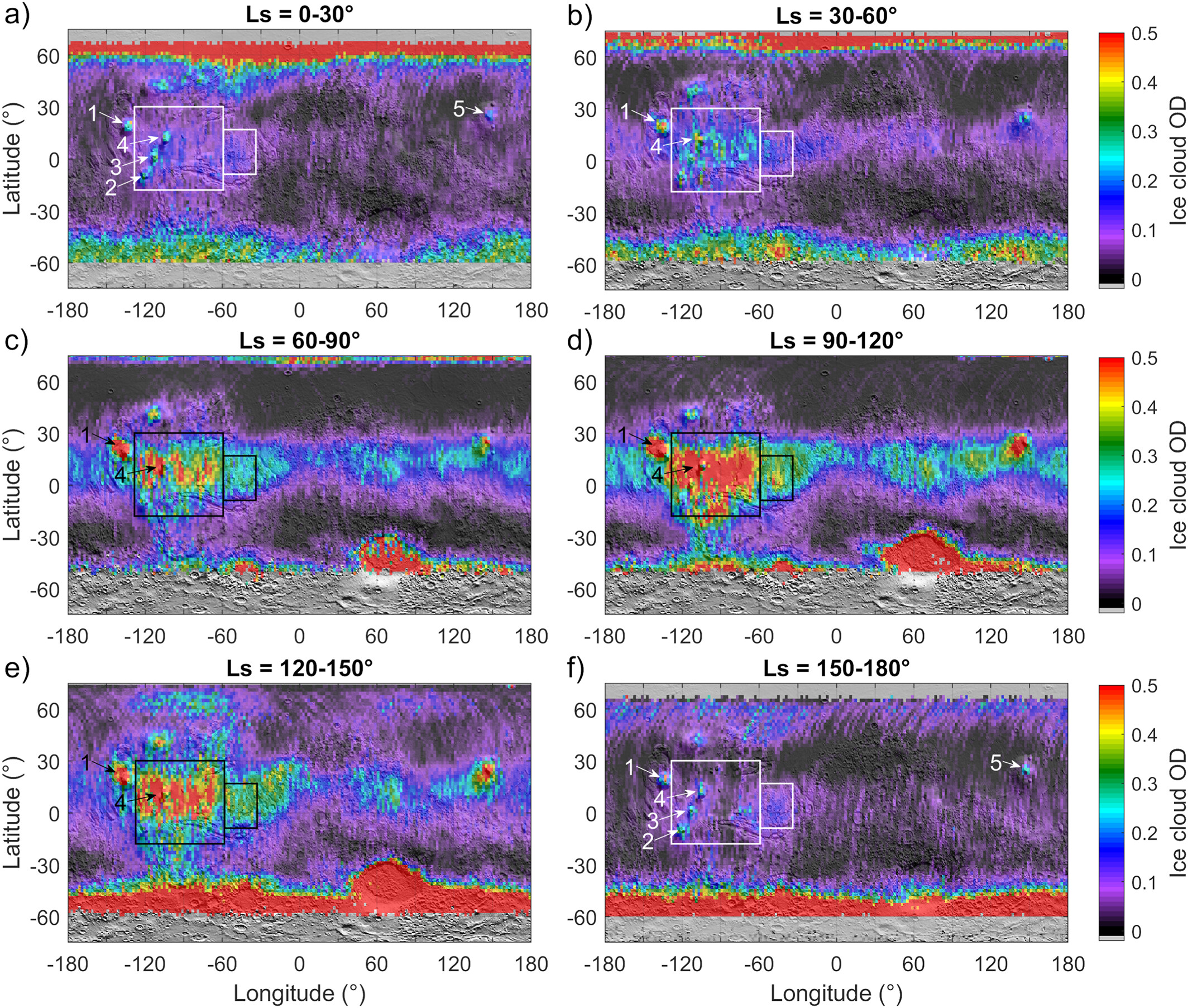
Spatial maps of the ice cloud OD for the first part of the Martian year (Ls = 0–180°) for six periods of 30° Ls (a–f). The maps were obtained by combining the data of MYs 35 to 38 contained in Figure 4 (and mixing all local times, cf. Figure 3b). These maps were obtained using the secondary retrieval mode, which derives ice cloud OD only, to include the cloudiness in Hellas. The retrieved difference between the primary (using 220–320 nm spectra) and the secondary (only 316 nm) remains generally limited (<±0.02)