
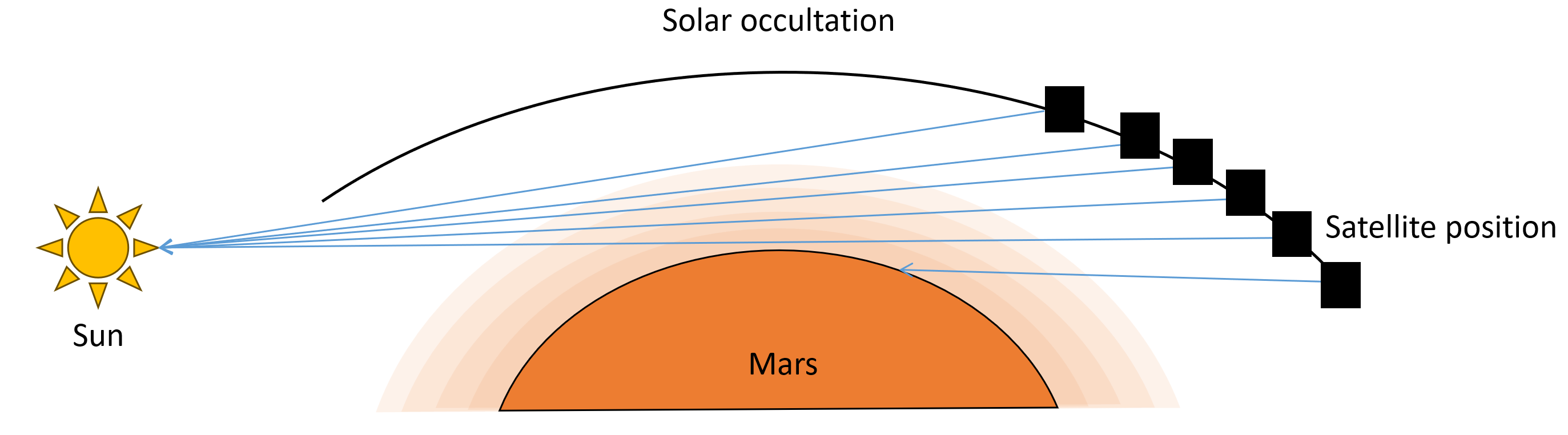
The atmospheric transmittance in the forward model depends on the viewing geometry, which for solar occultation observations is through the layers of the atmosphere:
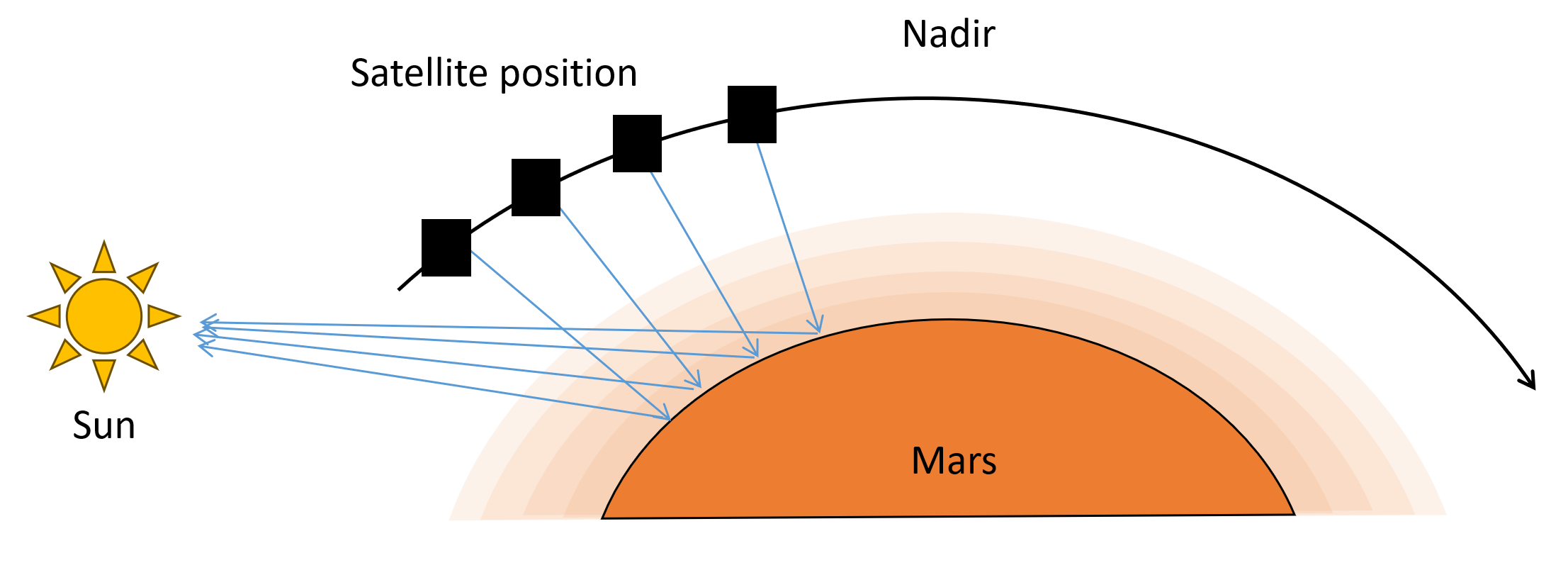
For dayside nadir, the sunlight passes through the atmosphere twice, along different slant paths, reflecting from the surface and scattering from the particles in the atmosphere:
A retrieval starts from a "best guess" of the atmosphere, based on a Mars global circulation model for each layer of the atmosphere at the same location and time as the observation. The atmospheric conditions for any location and time, where available, can be extracted from the GEM-Mars model running at BIRA-IASB. Below are two ways to get this information:
4a GEM-Mars atmosphere charts: on this page you can select a latitude, longitude, year, local time and solar longitude (Ls) corresponding to an observation and the vertical profiles are plotted. A link to download the json containing the data is displayed.
4b GEM-Mars atmosphere (python code): on this page you will find some python code to automate this task, enabling extraction of many atmospheric profiles from the BIRA-IASB server.
All calibrated NOMAD data products contain the required geometry parameters, plus on the page above there is code to convert UTC time to Mars year.